Showing posts with label Black History Month. Show all posts

Wednesday, April 8, 2026

Five Minute History: Christ's Institution Hospital

Our good friend, Johns Hopkins (the person, not the institution), who is the Executive Director of Baltimore Heritage, recently presented one of his amazing "Five Minute History" segments on the Christ's Institution Hospital. This was a combination medical school, nursing school, clinic and church for Baltimore's Black population in the early 1900s.

You can see the full five-minute video here. 


Thanks, Johns!

Friday, February 20, 2026

Black History Month Summary

Every year we are pleased to present information for Black History Month about the Black physicians who practiced in Maryland, and who were, for the most part, members of MedChi. 

In 1885, we changed our bylaws from "gentlemen members" to "persons" which included both Black physicians and women physicians. 

Unfortunately, the issue was revisited in the 1940s, with counties on the Eastern Shore and in Southern Maryland objecting to Black members, as MedChi became more of a social organization, rather than a medical society.

By the 1950s, things had been resolved and each county chose to accept Black members into their fold. 

For past posts on Black History Month, as well as the Black physicians who have practiced in Maryland, please click HERE.

Tuesday, February 25, 2025

Monday, February 17, 2025

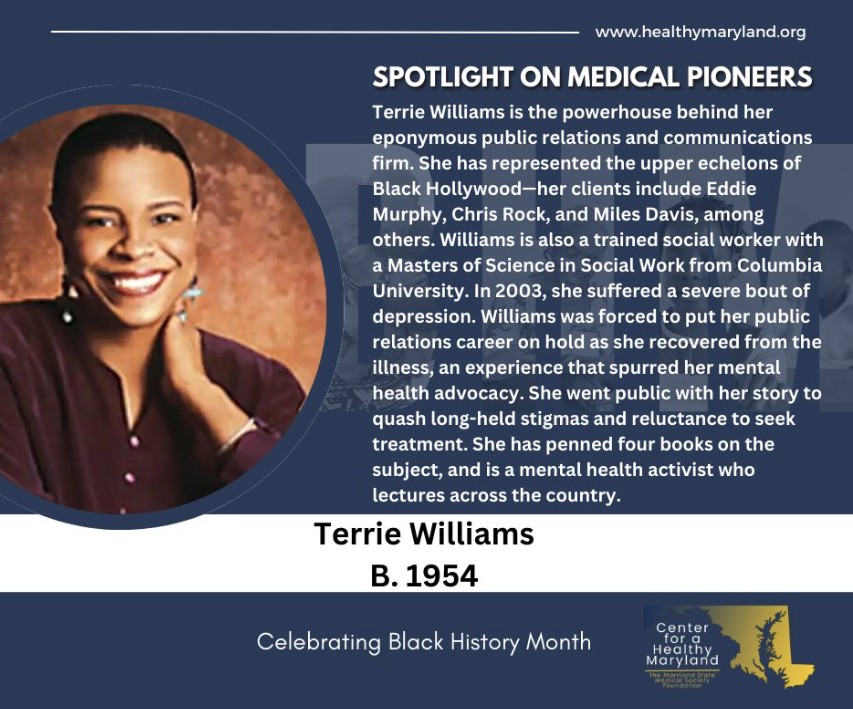
We Celebrate Black Medical Pioneers (Part 2)

The Center for a Healthy Maryland is publishing a series of brief biographies of medical pioneers on their Instagram account this month, and I will be sharing some of them here.  


Stay tuned for more!

Tuesday, February 11, 2025

We Celebrate Black Medical Pioneers! (Part 1)

In 1855, the Medical & Chirurgical Faculty of Maryland changed its by-laws to include both Black and Women physicians. Prior to that, they had read "gentlemen" members, which obviously didn't apply to women, and at the time, it also did not apply to Blacks. 

The Center for a Healthy Maryland is publishing a series of brief biographies of medical pioneers on their Instagram account this month, and I will be sharing some of them here. 


If you're interested in seeing what we've posted over the past years, please click here

A special thanks to Lindy Gapsis for posting these and sharing them with the History office.

Friday, February 23, 2024

Monumental Achievements in Black Medical History

 MedChi is doing occasional posts on Black Medical History. The "monumental" in the name comes from the Monumental Medical Society, a medical society for Black physicians. 

Stay tuned for more Monumental Achievements!

Thursday, February 8, 2024

Early Black Physicians in Maryland

The history of Black physicians in Maryland is long, but sadly, virtually un-explored.

One of the earliest reports of a Black physician practicing in Maryland dates from 1750. Henry Game, a freed slave in Somerset County on the Eastern Shore, was praised in the October 1750 issue of the Maryland Gazette as a successful doctor. He is also mentioned as a doctor in the register of the Stepney Parish in Somerset County in 1751.

Fast forward to 1818, when two men of color, Drs. Marlborough and Gibson were mentioned as practicing medicine without a license on the Eastern Shore.

In 1832, Dr. Lewis G. Wells was reputed to have attended the now-defunct Washington Medical College in Baltimore.

According to contemporary reports, it was likely that he studied at the university while working as an employee there, and reports also mention that he was one most skillful physicians of the day. He was Baltimore’s only Black physician at the time.
During the cholera epidemic in 1832, he was seen riding up and down the streets of Baltimore, administering to the sick and dying.

Samuel Ford McGill was the first Liberian colonist to receive a medical education in the United States. He also studied at Washington University, in 1836, but he was dismissed due to pressure from white students. He eventually attended Dartmouth University, where he graduated with a medical degree.

He returned to Liberia and became a colonial governor.

In 1882, the Medical & Chirurgical Faculty admitted its first Black member, Whitfield Winsey.

Dr. John Dunbar tutored Dr. Winsey in medicine, and in 1871, Winsey graduated from Harvard Medical School.
He returned to Baltimore and established a private practice on East Fayette Street. In April 1882, Dr. Winsey applied to the Baltimore City Medical & Surgical Society, but his membership was denied. Later that month, Dr. Winsey became the first Black member of the Medical & Chirurgical Faculty.

In 1894, Dr. Winsey, along with a group of prominent Black physicians, founded Provident Hospital on Orchard Street, the first private teaching hospital for Blacks in Baltimore.

Although Winsey was employed as a physician at Black institutions such as the Melvale Home for Colored Girls and Provident Hospital, he belonged to white fraternal and professional organizations, including the Medical & Chirurgical Faculty and the Masons. Dr. Winsey provided leadership for many aspects of nineteenth-century Black society in Baltimore.

The second Black member of the Faculty was Dr. Reverdy M. Hall, who became a member in 1884. He attended Howard University’s Medical College and graduated in 1872.

He opened a private practice on Druid Hill Avenue in Baltimore. There is some evidence that Dr. Hall was an OB/GYN, and he published a lengthy article in the Faculty’s 1890 Transactions, entitled “Fibroid Tumors Complicating Pregnancy."

Along with Dr. Winsey, Dr. Hall was one of the founders of Provident Hospital.

The Medical and Surgical School of Christ’s Institution of Baltimore City (also called the Medico-Chirurgical and Theological College of Christ’s Institution) was the first Black medical school incorporated in Baltimore. The school was still in existence as late as 1918. However, it graduated very few physicians and there is scant information about it and it doesn’t appear on the 1909 Flexner Report of Medical Schools.

In 1885, The Medical & Chirurgical Faculty of Maryland changed its constitution from “gentlemen members” to “persons” due to the number of Blacks and women who were becoming physicians and wanted to join.

Local reference materials list a number of other early Black medical societies, including:

·        The Maryland Medical, Dental, and Pharmaceutical Association.
·         The Maryland Colored Medical Association
·         The Maryland State Medical Association
·         MeDeSo – the Medical Dental Society, and finally,
·         The Monumental City Medical Society.

In 1983, MedChi elected Dr. Roland Smoot as its first Black president.

In 1963, Dr. Smoot was appointed chief of medicine at Provident Hospital, the same year Hopkins permitted him to have admitting privileges - a first for an African-American physician at Hopkins. In 1978, Dr. Smoot was named an assistant dean for student affairs at Hopkins and spent the next 26 years recruiting and counseling students at the school. 

MedChi is proud of its long history supporting Black physicians in Maryland.

Thursday, March 23, 2023

Highlights in the History of Black Physicians in Maryland

Coming in a little late for Black History Month with this article, but I just found it in the Archives, and thought I'd share it. Unfortunately, the document was un-dated, but I am guessing it was written sometime in the mid-1980s.

Highlights in the History of Black Physicians in Maryland

The history of Maryland’s Black physicians is long and virtually unexplored. One of the earliest reports of a black physician practicing in Maryland dates from 1750. Creating an accurate and complete chronology will be a challenging and consuming process for social and medical historians. The following chronology, while no means complete, attempts to highlight some of the major events in this history.

Eighteenth and Nineteenth Century References to Black Physicians

1750 - Henry Game, a slave in Somerset County, was given his freedom and praise in the October 29th Maryland Gazette, as a successful “Guinea Doctor.”

1818 - Two “men of colour” Marlborough and Gibson, mentioned as practicing medicine without a license on the Eastern Shore.

1832 - Dr. Lewis G. Wells is reputed to have attended the Washington University School of Medicine in Baltimore (now extinct) and to have been Baltimore’s only Black doctor in the ante-bellum period.

1836 - Samuel Ford McGill, the first Liberian colonist to receive a medical education in the United States, attended the Washington University Medical School in Baltimore, until he was dismissed due to pressure from white students. McGill eventually attended Dartmouth where he graduated with a medical degree in 1838. McGill was sent back to Liberia and eventually became its colonial governor.

Black Hospitals in Maryland

1865 - The Dr. G.W. Kennard’s Hospital, a proprietary establishment was formed. Dr. Kennard also established the Kennard Sanitorium during this period.

1894 - The Provident Hospital and Free Dispensary was formed.

1902 - William Bishop, MD, a Black physician, helped found the Annapolis Emergency Hospital (later Anne Arundel General Hospital). The constitution states that it was founded for “white and colored patients.”

Baltimore’s Black Medical School

1900 - The Medical and Surgical School of Christ’s Instution of Baltimore City (also called the Medico-Chirurgical and Theological College of Christ’s Institution) was incorporated. The school was still in existance as late as 1918. Apparently, it graduated very few physicians.

Maryland’s Black Physicians and Organized Medicine

Membership in the State Medical Society

1882 - The state medical society, The Medical & Chirurgical Faculty of Maryland, admitted its first Black member, Whitfield Winsey, MD

1884 - Reverdy M. Hall was admitted to membership in the Faculty. Dr. Hall was one of the founders of Provident Hospital, one of Baltimore’s earliest Black hospitals.

1885 - The Medical & Chirurgical Faculty of Maryland changed its constitution from “gentlemen members” to “persons” due to the number of Black and women who were becoming physicians and wanted to join.

1887 - William Henry Thompson was admitted to membership in the Faculty.

There were no additional Black members admitted to the Faculty until 1949.

1926 - Request made by a white physician on behalf of Dr. D.H.M. Williams for library privileges. Instead of confronting the issues, the Faculty took no action.

1939 - George McDonald, MD, a Black physician and president of a local Black medical society, writes a letter in changing the state’s medical society’s position on allowing library privileges to Black physicians.

1940 - The Faculty votes to allow library privileges to all Black members who are members in good standing of the Black medical society, as well as to allow Black physicians to attend all scientific meetings at the Faculty.

1949 - The Faculty voted to accept Black physicians as full-fledged members. However, it was decided that component (i.e. county) societies could elect Black members at their own discretion.

1973 - Aris T. Allen, MD, a noted civic leader and two-term state legislator, as well as physician, became the first Black officer when he was elected Second Vice-President of the Faculty.

1976 - Dr. Allen was once again elected, this time as Vice-President.

1983 - Dr. Roland T. Smoot, a prominent Black physician was elected as the Medical and Chirurgical Faculty’s first Black president in its [then] 185 years of existence.

Scientific Societies

The Clinical Society of Maryland was organized in 1875 for the advancement of medical science. It existed until 1901 when it merged with the Medical & Chirurgical Faculty.

1883 - Dr. Whitfield Winsey and Dr. Reverdy M. Hall were admitted to the membership in the Clinical Society of Maryland without protest. Both physicians were active participants of the society.

Maryland’s Black Medical Societies

Early in the 1900s, Maryland’s Black physicians formed the Maryland Medical, Dental, and Pharmaceutical Association. Local reference materials list a number of other Black medical societies. Whether these were all the same organizations, or separate ones is not clear. Their names were:

  • The Maryland Colored Medical Association
  • The Maryland State Medical Society (or Association)
  • MeDeSo – the Medical Dental Society, and finally,
  • The [then] current Black medical society in Baltimore, the Monumental City Medical Society.

Currently (document is un-dated), there are two additional Black medical societies, in addition to the Monumental City Medical Society. They are the W. Montague Cobb Medical Society, organized in the mid-1970s for Black physicians in Howard County; and a statewide Black medical society, which is an affiliate of the National Medical Association, a nationwide Black medical society.


Thursday, February 23, 2023

New Acquisitions on the History of Blacks and Medicine

As I have been going through the 23 cases of books which we recently re-acquired from the Maryland Center for History and Culture, I found some books on the history of Blacks and medicine. Please excuse the poor quality of the photos.

The first one I discovered was "The First Negro Medical Society: The History of the Medico-Chirurgical Society of Washington, D.C." which was active from 1884-1939. It was written by W. Montague Cobb, A.B., M.D., PhD., who was a professor of anatomy at Washington DC's Howard University, and was written in 1939. 

Here is the list of chapters which wend their way through the history of the organization.

The second book is "A Century of Black Surgeons, Vol. II." I haven't come across Vol. I yet, but I am hoping that I do. 

This book was published in 1987, and is a series of stories about people and institutions. Here's a sample:
You will see on this list Mr. Vivien Thomas, who assisted Dr. Alfred Blalock at Johns Hopkins. 

Next up is "Negros for Medicine: A Report of a Macy Conference." It was published in 1968 in Baltimore by the Johns Hopkins University Press. Here is a list of the participants in the conference, which was held in June of 1967.

Finally, there is the book, "Germs Have No Color Line: Blacks and American Medicine, 1900-1940." This was published in 1989 by Vanessa Northington Gamble. This looks to be a series of articles taken from various medical journals over the years. 
If you would like to see any of these books, please email me and we can set up an appointment for you to visit.  
 

Friday, February 17, 2023

Provident Hospital, Baltimore's First Black Hospital

Provident Hospital and Free Dispensary was founded in 1894 at 419 Orchard Street, a neighborhood where several hospitals serving the white population were already located. At that time, admitting black patients to white hospitals was basically prohibited. Black patients still needed care and treatment, so a small group of doctors started Provident Hospital. 

The founders included Dr. William T. Carr, Sr. (above) and Dr. J. Marcus Cargill. They wanted to provide an institution where people of color could be attended by physicians of their own race, and that colored physicians might have an opportunity to develop themselves in their specialties and become proficient in them. They also wanted to establish a well-organized training school for nurses. 

Among the early physicians at Provident were three Black physicians who were admitted as members of the Medical & Chirurgical Faculty of Maryland in the 1880s, when the organization’s by-laws had changed members from “gentlemen” to “persons.” The first admitted was Whitfield Winsey, M.D. who became a pupil of Dr. John R.W. Dunbar, a professor of surgery at Washington University and received his medical degree from Harvard in 1877. Next was Reveredy M. Hall, M.D. a Baltimorean who graduated from Howard as a medical doctor in 1872 and was dean and director of Provident Hospital. The third was William H. Thompson, who was born in Yonkers, NY in 1849 and received his doctorate degree at Howard University in 1872.

The hospital soon outgrew its home on Orchard Street and in 1896, the hospital moved to 413 W. Biddle Street, where there was room for 30 beds and an adjoining building for the nurses’ training school.

The Provident Training School for Nurses was the first and only institution in the are to offer Black women the opportunity to train as nurses. The school received official recognition in 1926 and was renamed the Provident Hospital School of Nursing.

Over the years, Provident Hospital went through highs and lows. When Union Memorial Hospital moved to its current location on 33rd Street, Dr. J.M.T. Finney suggested that Provident buy the building on Division Street for $75,000. The new building opened on October 15, 1928 with Dr. William T. Carr as superintendent. Sixteen Black physicians were appointed to the visiting staff and had privileges to treat private patients.

The AMA approved a plan to train six interns in a general rotating program. There were residencies in pediatrics, general surgery and anatomic pathology. Provident was one of five hospitals in the United States that provided specialty training for Black physicians.

Provident stayed at the Division Street location until the late 1960s when construction commenced on a building on Liberty Heights Avenue, and was occupied in 1970. By the mid-1970s, the hospital’s main concern was the integration of Black physicians and patients into previously all-White hospitals which siphoned potential patients from Provident Hospital. In addition to the financial de-stability this caused, the hospital was surrounded by low-income neighborhoods.

Not all news was bad, as surgical and obstetrical residents and summer students rotated though Provident from Meharry Medical College. A hypertension program with numerous outreach facilities was assisted by a significant grant-in-aid. And a cancer-screening clinic, funded by the Morris Goldseker Foundation was entirely free for participants.

In 1985, a low occupancy rate along with financial difficulties, including poor cash flow led to the closing of the hospital. But in 1986 the hospital merged with Lutheran Hospital and formed Liberty Medical Center.

Lutheran Hospital began in the 1870s in West Baltimore as the Hebrew Orphan Asylum.

In the 1920s, when the Hebrew Orphan Asylum moved to where Sinai Hospital is now located, the hospital became West Baltimore General Hospital. By 1939, the hospital contained 100 beds, a nurses’ quarters, maternity wing and power plant. After World War II, it became Lutheran Home and Hospital.

In the 1990s, a partnership with Bon Secours Hospital, Liberty and other community-based health centers was formed to become the Community HealthCare Network of Baltimore. As medical care changed, and fewer and fewer patients actually stayed at hospitals for any signficant amount of time, Liberty Medical only had a 10-15% occupancy rate, not enough to keep the doors open.

In August of 1999, Liberty Medical Center, which had 282 beds and employed about 400 people on the 15-acre campus on Liberty Heights Avenue, closed. From a small hospital that began in a row-house in 1894 to large urban medical center, Provident’s history for caring for the Black population of Baltimore has not been forgotten.


Sources:
Maryland Medical Journal, April 1997
Journal of the National Medical Association, May 1967
Baltimore Sun, August 8, 1999

Monday, February 28, 2022

Black History Month

The 2022 Black History Month's theme is Black Health and Wellness and MedChi is celebrating and highlighting the contributions and breakthroughs of Black physicians. We thought we'd share some of the Black physicians that MedChi's media team highlighted over the past month. 


This is a small percentage of the talented Black physicians, but we hope that we've introduced to a few of them whom you might not know.