Thursday, August 4, 2016

The Other Building

As we have been going through some files this summer, we came across a file on the “new” building, which is actually older than the “old” building.building 005
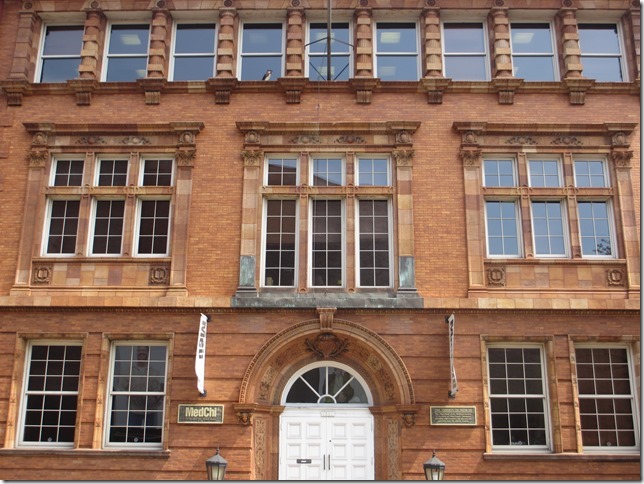
The building was designed in 1898 by Joseph Evans Sperry who began practicing architecture at age 16 in his own office. But several years later, he was working with Francis Baldwin, a major architect in Baltimore. In 1877, he re-opened his own practice. By 1889, his office was in the old Central Savings Bank building on the SE corner of Lexington and Charles Streets, originally the Lorman house, designed by Robert Cary Long, Sr. and remodeled for the bank by George A. Frederick.

In 1896 he moved his office to the Herald Building which he had designed, remaining there until it was destroyed in the Fire of 1904.  In 1905, he relocated to the reconstructed Calvert Building which he had also designed. Sperry is best known for designing the following:image
In 1898, William S. Marston bought a tract of land between Cathedral Street and Maryland Avenue, and soon opened Marston’s University School for Boys. Several other private schools were located in the general vicinity, including Boys’ and Girls’ Latin, Bryn Mawr and Friends. The main building at Marston's included study halls, a library, a kitchen and lunch room, an exercise and drill room, and restrooms. The gymnasium building included gymnastic equipment and an elevated running track.

The exterior facades of the buildings, in brick, brownstone and terra cotta, are done in a Romanesque design, and are still considered architecturally distinctive.
building 001x IMG_2962x IMG_2967x
Boys from Marson were not allowed to go to any event at Bryn Mawr, just across the street. However, in 1906, a student dressed in girl’s clothes and successfully attended a gymnastic exhibition. During dances at Bryn Mawr, the boys would tie the doors shut with ropes, requiring someone to come cut them free.
In 1908, the school moved to Charles Street and North Avenue, and then to Riderwood. It eventually closed in the late 1930’s, after Marston’s death.
building 003x
In 1908, the City purchased the building for $50,000 to use as a public school for accelerated junior high students. In 1910, the school had almost 400 students and TWELVE teachers, only one of whom was male. The school was named for Robert E. Lee.
school 29
In 1962, the school underwent a transformation from academic education to more practical learning, and in 1969, it closed. But in 1970, it re-opened as a school for teenage mothers so they could complete high school.

The school finally closed for good in 1977 and in 1978, MedChi bought the building, reputedly for $1.00. Construction began in 1984 and was completed the following year.

Monday, August 1, 2016

The “Priestess”

I was scanning through the Baltimore Sun’s archives when I found a few old articles on our Marcia. priestess-1

Of course, I can never resist playing around with images, so I added the portrait of “Mr. Smith”, which Marcia loved. She had persuaded the Library Committee to buy the painting, and she said that if she ever left the Faculty, she’d secretly pack him into her suitcase. But she didn’t have to, because the physicians made her a gift of the portrait.

priestess-2

When Marcia died, there was an announcement of her death, obit 1

and then after her funeral, there was another piece in the Baltimore Sun, talking about the event. obit 2

It is always fascinating to find contemporary writings about our well-known members and staff.

Tuesday, July 26, 2016

Bird’s Eye View of Baltimore, Circa 1911-1912

I was looking for a turn of the century (the last one) map of Baltimore and stumbled across a map I’d never seen. It’s not actually a map, rather a bird’s eye view of the city, several years after the Great Baltimore Fire in 1904, highlighting what had been accomplished in a scant seven years.

The view comes from somewhere high above South Baltimore, and stretches all the way up past the mills on the Jones Falls in Hampden and Woodberry. The map is phenomenally detailed, with many buildings being clearly identifiable, even 100+ years later. 1912 capture

You can easily see the Washington Monument, image

the Johns Hopkins medical campus, imagethe Camden Yards warehouses, image

Davidge Hall and the Bromo Tower, image

and so much more. I am pretty certain we could probably pinpoint the MedChi 1909 Building, but I haven’t been able to locate it yet.

Of course, I can’t leave well enough alone, so I applied my mad Photoshop skills to it while listening to the convention speeches, and colourized the map, mostly with brick red, copper and forest green and some pale blue, although we all know perfectly well that the Harbour and the Jones Falls never looked like that. I think that the colour gives the piece a lot of depth. 1912 capture colour

Although it’s not quite to scale, it’s a pretty amazing piece of work, originally done in pencil by Mr. Edward Spofford in the fall of 1911. There’s not a lot of information about this piece, like who comissioned it, and how it was sketched.

You can download a huge file of the map from the Library of Congress, here. It’s such fun to sit and search the image and see what you can recognize.

Thursday, July 14, 2016

Nutshells Lecture a HUGE Success!

MedChi hosted our first ‘pop-up” lecture on July 13th, and it was a stellar success! More than 150 people registered for the event, and we were still receiving requests for tickets up until 15 minutes before it started! Osler Hall was filled with members of the public who are clearly happy to be attending the lecture. image

And our speaker, Bruce Goldfarb, front and center in this selfie, was a huge hit with his detailed lecture on the Nutshells and their creator, Frances Glessner Lee. After he finished the lecture, Bruce entertained questions from the crowd, and afterwards crowded around to ask even more questions.

Because of the popularity of this lecture, we discussed presenting it again in the spring.

We are already planning to do a lecture around Halloween, and I bet you might be able to guess who and what it will be about!

Friday, July 8, 2016

Looking for Information on Russell Fisher, M.D.

In the course of preparing for next week’s lecture on the Nutshells, I found out that Russell Fisher’s grand-daughter will be here for the lecture. She’s preparing a documentary on him and is looking for anyone who was a contemporary of Dr. Fisher’s who might be willing to talk to her. image

Dr. Fisher was generally thought of as the father of forensic pathology and did a tremendous amount to professionalize the field. He was active in MedChi and was President in 1969. We have a lot of information that he’s written, or that was written about him, but personal stories add a lot of depth.

Please email me here and let me know if you’d be willing to speak to Dr. Fisher’s grand-daughter.

Thanks!

Tuesday, July 5, 2016

Yikes!

I am going through all sorts of old files in order to cull those that are important, and chuck out those that have no relevance (like the one on painting the interior of the building).

The files contain all sorts of correspondence, some pieces more interesting than others. I came across this letter from the editor of the Baltimore Sun, dated sometime last century, and thought it was equally funny and horrifying!

Take a look.IMG_0012

It is pretty impossible to think that a contemporary editor would ever send a letter or email like this to a reader.

Sunday, July 3, 2016

Happy 4th of July!

Marcia, along with the staff and Board of MedChi and the Center for a Healthy Maryland,
wishes you a safe and happy Independence Day.