Tuesday, July 26, 2016

Bird’s Eye View of Baltimore, Circa 1911-1912

I was looking for a turn of the century (the last one) map of Baltimore and stumbled across a map I’d never seen. It’s not actually a map, rather a bird’s eye view of the city, several years after the Great Baltimore Fire in 1904, highlighting what had been accomplished in a scant seven years.

The view comes from somewhere high above South Baltimore, and stretches all the way up past the mills on the Jones Falls in Hampden and Woodberry. The map is phenomenally detailed, with many buildings being clearly identifiable, even 100+ years later. 1912 capture

You can easily see the Washington Monument, image

the Johns Hopkins medical campus, imagethe Camden Yards warehouses, image

Davidge Hall and the Bromo Tower, image

and so much more. I am pretty certain we could probably pinpoint the MedChi 1909 Building, but I haven’t been able to locate it yet.

Of course, I can’t leave well enough alone, so I applied my mad Photoshop skills to it while listening to the convention speeches, and colourized the map, mostly with brick red, copper and forest green and some pale blue, although we all know perfectly well that the Harbour and the Jones Falls never looked like that. I think that the colour gives the piece a lot of depth. 1912 capture colour

Although it’s not quite to scale, it’s a pretty amazing piece of work, originally done in pencil by Mr. Edward Spofford in the fall of 1911. There’s not a lot of information about this piece, like who comissioned it, and how it was sketched.

You can download a huge file of the map from the Library of Congress, here. It’s such fun to sit and search the image and see what you can recognize.

Thursday, July 14, 2016

Nutshells Lecture a HUGE Success!

MedChi hosted our first ‘pop-up” lecture on July 13th, and it was a stellar success! More than 150 people registered for the event, and we were still receiving requests for tickets up until 15 minutes before it started! Osler Hall was filled with members of the public who are clearly happy to be attending the lecture. image

And our speaker, Bruce Goldfarb, front and center in this selfie, was a huge hit with his detailed lecture on the Nutshells and their creator, Frances Glessner Lee. After he finished the lecture, Bruce entertained questions from the crowd, and afterwards crowded around to ask even more questions.

Because of the popularity of this lecture, we discussed presenting it again in the spring.

We are already planning to do a lecture around Halloween, and I bet you might be able to guess who and what it will be about!

Friday, July 8, 2016

Looking for Information on Russell Fisher, M.D.

In the course of preparing for next week’s lecture on the Nutshells, I found out that Russell Fisher’s grand-daughter will be here for the lecture. She’s preparing a documentary on him and is looking for anyone who was a contemporary of Dr. Fisher’s who might be willing to talk to her. image

Dr. Fisher was generally thought of as the father of forensic pathology and did a tremendous amount to professionalize the field. He was active in MedChi and was President in 1969. We have a lot of information that he’s written, or that was written about him, but personal stories add a lot of depth.

Please email me here and let me know if you’d be willing to speak to Dr. Fisher’s grand-daughter.

Thanks!

Tuesday, July 5, 2016

Yikes!

I am going through all sorts of old files in order to cull those that are important, and chuck out those that have no relevance (like the one on painting the interior of the building).

The files contain all sorts of correspondence, some pieces more interesting than others. I came across this letter from the editor of the Baltimore Sun, dated sometime last century, and thought it was equally funny and horrifying!

Take a look.IMG_0012

It is pretty impossible to think that a contemporary editor would ever send a letter or email like this to a reader.

Sunday, July 3, 2016

Happy 4th of July!

Marcia, along with the staff and Board of MedChi and the Center for a Healthy Maryland,
wishes you a safe and happy Independence Day.

Thursday, June 30, 2016

The Nutshell Studies in a Nutshell

With the lecture about the Nutshell Studies of Unexplained Death, just under two weeks from now, I thought I would give you a bit of background about them.

These fascinating Nutshell Studies were created in the 1940’s by Francis Glessner Lee, an heiress to the International Harvester Fortune.image

She had wanted to attend university to study law, but was not allowed and instead was taught how to knit and sew and other domestic pursuits. Through a friend of her brother’s, she came to be interested in early forensic medicine, but realized that police officers and coroners didn’t take the time to “read” a crime scene, and often destroyed any remaining clues.IMG_0828[3]

Mrs. Lee’s brother’s friend was on the faculty of Harvard University, and Mrs. Lee created the Center for Legal Medicine, donated thousands of medical books, and endowed a chair for legal medicine in 1931. She also created the Harvard Associates in Police Science (now administered through the MD-OCME). When the legal medicine department closed in the early 1960’s, the Nutshells came to Baltimore with Russell Fisher, M.D., a professor who was joining Maryland’s Medical Examiner’s office.image

Mrs. Lee was convinced that if you could read the clues, you could solve the crime and began recreating crime scenes, on a scale of one inch to one foot. Her first Nutshell, an old barn, took three months to build. She used weathered wood from an old barn and cut each of the shingles on the roof.woodshed

The detail on these is incredible. She knit a tiny blanket on straight pins.image She even fashioned a tiny teddy bear from the knitting.image

All labels, fabrics, furniture, accessories and every single thing in each room were created by hand. One one wall, there’s a calendar, but she didn’t have just the one month printed, she had the subsequent six months behind it. Appliances and utensils came out of Cracker Jack boxes, or were charms from charm bracelets, one of which was 14k gold, painted silver. kitchen

But what is MedChi’s role in all of this? In the late 1930’s, the Faculty received a proposal during the House of Delegates meeting to create a state-wide medical examiner’s office, instead of the more common county coronor system which is still in use in most of the US. The proposal was studied for a year, and then voted on by the membership. It passed, and was put into law by the Maryland General Assembly in 1939.

Russell Fisher, M.D. was the second Chief Medical Examiner and held the position for more than 35 years. imageHe was a very active member of MedChi, serving as President of the organization in 1969. The legal suite at MedChi is named in his honor.

Wednesday, June 15, 2016

The Nutshell Studies of Unexplained Death Lecture

MedChi, The Maryland State Medical Society
and the Center for a Healthy Maryland Present
A Pop-Up Lecture for Artscape Week

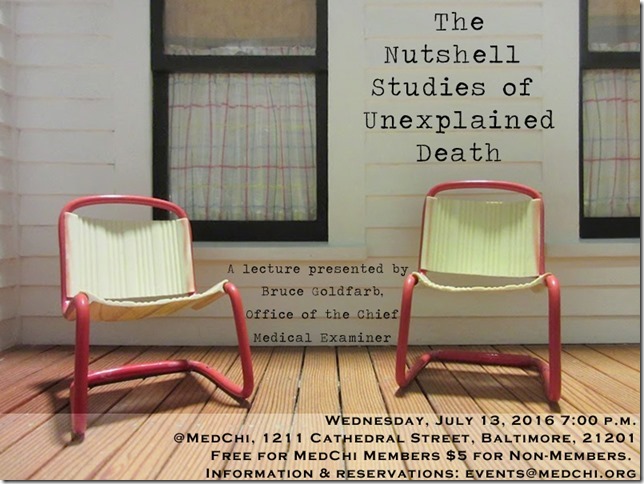
2nutshell

The Nutshell Studies of Unexplained Death
One of Baltimore's Hidden Treasures

With
Bruce Goldfarb, Office of the Chief Medical Examiner

Wednesday, July 13, 2016
7:00 p.m. Lecture & Discussion

The lecture will be held at Osler Hall
MedChi, The Maryland State Medical Society  
1211 Cathedral Street
Baltimore, MD 21201

Plenty of free and paid parking available in the area.

The event is free for MedChi members and $5.00 for non-members.

Registration is requested. MedChi Members, please RSVP to events@medchi.org.

Please click here to purchase tickets. You will be taken to a third-party site.
Names will be held at the door.

U P D A T E :
Here’s a great article about the Nutshells that just appeared on the National Geographic’s Gory Details blog!