It's Just a Shock to Realize That 2025 is Over and We're Entering 2026!

Cheers!
Best Wishes for a Happy and Prosperous New Year!

It's Just a Shock to Realize That 2025 is Over and We're Entering 2026!
Cheers!
Best Wishes for a Happy and Prosperous New Year!

For the past 10 years or more, I have been dressing Marcia for the holidays.
This year, I made a compilation of a number of these images!

It was 79 years ago today that Marcia Crocker Noyes took her last quiet breath at the Eudowood Sanitarium (below) in Towson, Maryland. She died just a few days after the 50th anniversary of her hiring at the Medical Faculty.


Marcia had just returned from the Medical Library Association's Annual Meeting in New Haven, CT. The experience exhausted her, and at the party, she had lost much of her voice.
Years before, she had convinced the Library Committee to purchase a painting at auction, and had always said that if/when she retired, she was going to sneak the painting into her valise.


For decades, there have been stories of staff members and others hearing footsteps echo in the hallways or on the stairs, finding items which appear with no explanation, or catching a glimpse of a figure out of a corner of an eye...


A few weeks ago, I received an email from someone in Vermont whose family had owned the property that was Marcia Noyes' Camp Seyon (Noyes in reverse) on Lake George.

Marcia ran a summer camp for girls for a number of years, finally selling the property in the 1930s. We have old advertisements for the camp, recruiting both counselors and campers.

At first, the only building housed the kitchen with its huge, wood burning, cast iron stove and the great room with floor to ceiling book shelves, used principally as a dining hall for the girl's camp that had existed there since the turn of the century.
From an article about the property I found online:
The girls slept on narrow, World War I army cots in large canvas tents rigged on wooden platforms. Marcia Noyes (Seyon is Noyes spelled backward), who ran the camp, was an internationally known medical librarian at
Johns Hopkins Universitythe Medical & Chirurgical Faculty of Maryland.
Johns HopkinsThe Faculty provided her a penthouse apartment in Maryland and the Medical Librarians Association still gives out a yearly award in her honor. But Miss Noyes' summers were dedicated to the camp and her girls. Marcia had the Main House floated down from an island in the Narrows on a barge as the Camp was, then, a virtual island. A boggy path led across the isthmus to the peninsula but vehicles were left on the mainland.
After she sold the Camp, it seemed to remain in one family for several generations. When they finally sold it in the early 2000s, they kept a lot of things from the property. Among the items were some pieces from the Camp Seyon years.

As one of the descendants was going through the papers, etc. he realized that they should be with Marcia's documents at MedChi, and not with the family, so he kindly sent them to us!
There were numerous ink printings of various ferns from the property, along with the scientific names and descriptions, all in Marcia's handwriting.


Here are some more pieces which were in the box.


I am so pleased to announce the publication of "Marcia Crocker Noyes: The Librarian Who Never Left," a biography of our librarian of 50 years.

When we built our current building in 1909, she was highly involved in the design of it, as it was also to become her home. Marcia died in 1946 and her funeral was held in Osler Hall, a fitting testimony to her long friendship with Dr. Osler.
Of course, we've all heard stories about how she's never left the building. In fact, in her latter years, she mentioned that she would stay away for a few days, and then come back to haint (haunt) the building. And indeed, she has!
The book is available in two formats: an 80-page soft-cover edition for $30.00, and a digital format for $5.00. The funds raised by the sale of the book will be used to support the MedChi archives.
To purchase the book in either format, either scan or click the QR code below.

A few days ago, a friend sent me an auction listing for a book that was once owned by our Sir William Osler.

All of the very best wishes for the holiday season!

Marcia and the rest of the team at MedChi hope that your holidays are warm and bright!
I was asked to give a talk at the Osher Learning Institute at Towson University. Since the topic was Spirits and Ghosts, I chose Marcia, naturally!
“In making a living, I made a life.” So were the immortal words of Marcia Crocker Noyes, MedChi’s librarian for 50 years.
Marcia was born in Saratoga, New York in about 1870.


Marcia and Kitty both worked at the Enoch Pratt Free Library where Marcia cataloged books.
In 1896, when Dr. William Osler became President of the Medical & Chirurgical Faculty (known then as the Faculty), he was dismayed to find that the condition of the library and the resident librarian were both in shambles.

Back to Marcia. Osler called his friend who was President of the Pratt to see whether he knew anyone who could work as the Faculty’s librarian and live on the premises. That person was to revitalize the library, whose books were out of date and out of order. Marcia was hired and within two weeks, she had a brand-new job and was living at the Faculty’s building on Hamilton Terrace.

The Faculty’s members initially saw Marcia as a young woman who knew nothing about medicine. Luckily, she had Dr. Osler in her corner. Both Osler and Marcia believed in mixing the younger and older physicians in conversation, and she subscribed to numerous medical journals, so that members would come to the Faculty to read and discuss them.

Marcia needed to
be available 24/7, so she needed to live on-site. For example, a physician
might call and ask for an ophthalmology book because his patient’s eyeball fell
out. Marcia would check the card catalogue, and then go find the book. The
physician would arrive, read up on eyeballs and then be on their way. She was
our early Google.
In 1898, Dr. Osler, Marcia, and two other librarians created the Medical Library Association, which still exists today, and whose highest award is given in Marcia’s name.

After the Faculty outgrew Hamilton Terrace, Marcia acted as project manager for the construction of the building on Cathedral Street.


Befitting a young woman who had her own car in the 19-teens,
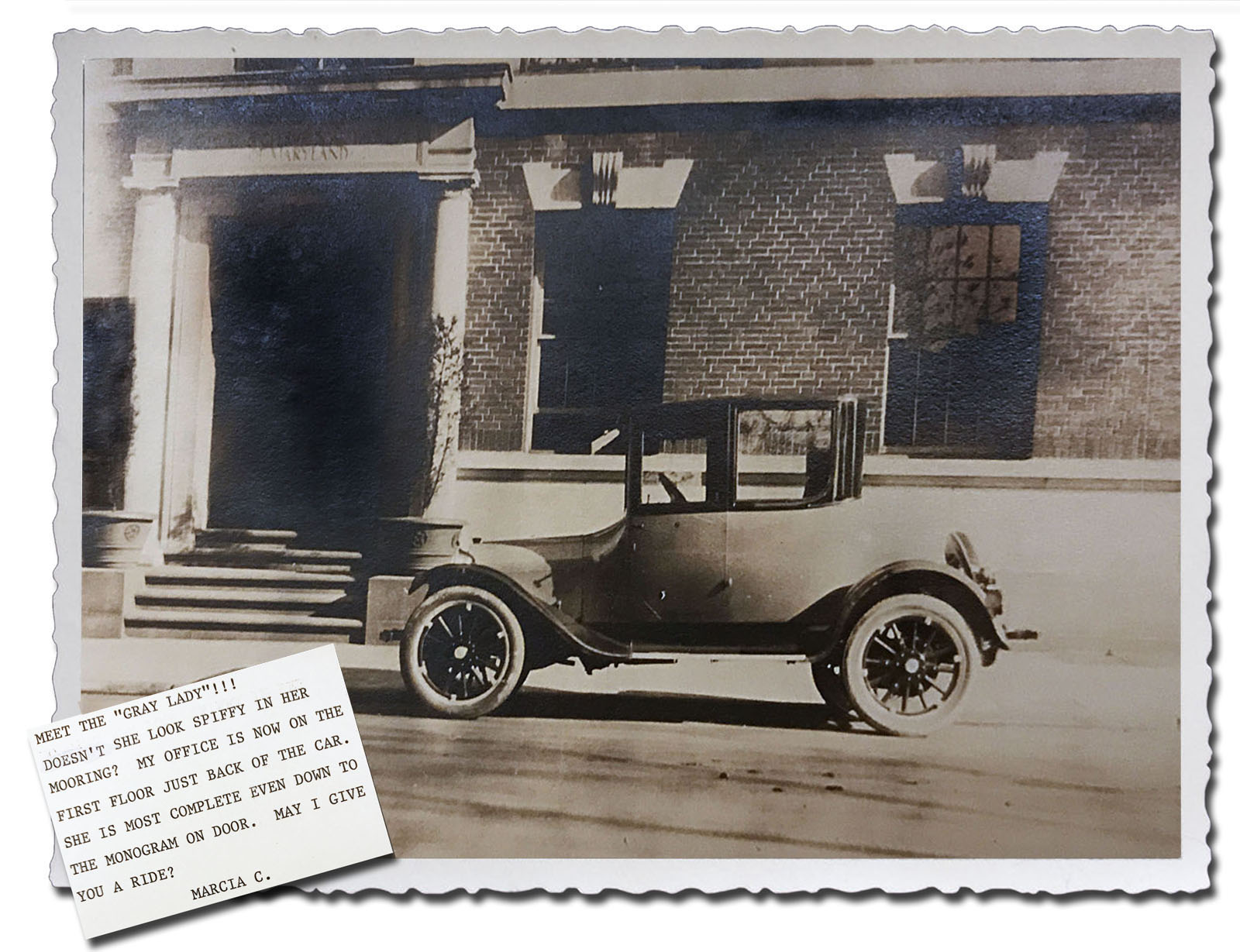

As she aged, she slowed down considerably, and the Faculty members planned to host a huge party celebrating the 50th anniversary of her hiring. But being physicians, they doubted she would live until then, so in April of 1946, they held the party, regardless.

Marcia Crocker Noyes died on November 24, 1946, just four days after her 50th anniversary at the Faculty. Her funeral was held there, with 60 physicians acting as pallbearers. She is buried at Green Mount Cemetery in Baltimore, along with her sister, Kitty.

And this brings me to the second part of my talk this evening. It always sounds a little bit bonkers to talk about our ghost at work, but it’s actually as much of a reality as it can be.
Marcia lives on in the building which meant so much to her.

Marcia lived in our building from the time it was built in 1909, until her death.

Beginning in the 1970s, stories written by one of the latter librarians begin to appear in our medical journal. He talks about being in the office on a weekend, knowing that there’s not anyone else in the building, but hearing footsteps in the hallway.

He tells another story of the library employees hearing steps on the metal
stairs of the stacks, and the squeak of the wheels of one of the old wooden
book carts. It just can’t be explained away with an easy answer.
The most re-told story is about our former housekeeper, Letha, who used to come at seven in the morning to make coffee for us and clean up from the previous evenings’ meetings.

When she told people what happened, someone showed her an old photo of
Marcia, and Letha recognized her immediately. After that, Letha would never come
into the building unless she knew someone was already there.
When I began working at MedChi, people always talked about Marcia when
anything went awry. After a few months, I read that the physicians would give
Marcia bouquets of flowers when she did a special favor for them. And then I
heard that the highest award at the Medical Library Association, which she had
co-founded, was given in Marcia’s name, but that somehow, MedChi, the place
where she spent her entire career, was never mentioned in conjunction with her.
I decided to remedy that.

But that was just my first interaction with her. I was doing a lot of research in the stacks which is where our archives are located. I pride myself on being pretty observant.
.JPG)
I still find things in the stacks. I was recently working on the rare
books collection, and as I was walking out of the stacks, I noticed a large,
rounded frame peeking out from behind a file cabinet. I pulled it out, and low
and behold, it was an old portrait, and it happened to be one I had been
looking for. It was of the historic physicians, who has one of my favorite names:
Peregrine Wroth. Of course, I should tell you that my second favorite name is
the doctor, Clotworthy Birnie.
I also know, without a doubt, that the items were not there before. How
could they just have appeared? Where did they come from?
A few years ago, after the pandemic, we realized that we had a lot of
extra space, since many of our staff were working from home. We shifted most of
the offices in the 1909 building over to our adjacent building. We then
converted some of that space into the small MedChi Museum of Maryland Medical
History, open by appointment only.
A few of us spent the Saturday prior to the Museum’s opening at the office doing final installations.


The evening before the opening, we were doing that frantic last-minute
detail work. We had put light-weight drop cloths on the walls to protect the
displays, and all of a sudden, they started billowing in a breeze! We couldn’t
feel a breeze, but could see the plastic moving, and there is no HVAC in the
museum room. It was a bit scary, but we rationalized that it must have been
Marcia coming to check out what we were doing.
I hadn’t seen Marcia, only had arms-length interactions with her… until
last fall. I was working in the rare book room, and walking down the hallway
towards our Osler Lecture Hall. I saw someone, clearly a woman, walk across the
Lecture Hall, but couldn’t discern who it was. When I walked into the room,
there was clearly no-one there. But I knew I’d seen someone. It took me a few
minutes to wrap my head around what had happened, but I was pleased that she’d
finally made herself seen.
A few weeks later, a colleague stopped me to tell me that she and one of her co-workers had just seen Marcia. They were in a meeting to discuss confidential medical cases and saw a woman walking down the hallway with books in her arms, heading towards the marble stairs.

Earlier this year, we had our 70-year-old intern working on our rare books collection.

We always dress Marcia for the holidays, so I thought I’d share some of the past ones with you. I haven’t had a chance to dress her for this year yet!

Since I switched jobs a few months ago to focus solely on the history of medicine, my new office is located in Marcia’s old office.

So far, nothing
like that has happened to me, but then, I’ve only been in her office for two
months. However, I am planning on working on a biography of Marcia sometime
this year, and I have a feeling she’s going to be sitting on my shoulder
correcting things that I’m writing.
Funnily enough,
last week as I was wrapping up my slide show, and getting ready to send it to
Tracy, my computer blinked out for a second, and when it came back on, the only
document that I lost was the slide show. Coincidence??? Who knows.
I grew up in an
old house where odd things routinely happened. And then I worked in a 12th
century castle on the coast of Wales, so, as they say, I ain’t afraid of no
ghosts.
Especially one who is a good spirit, like our ghost, Marcia Crocker Noyes.

Thank you.
If you have been reading this blog for any length of time, you know that Marcia plays a big role in our history! She was appointed as the first Executive Secretary in 1903 and worked for the "Faculty" from 1896 to 1946. She lived on the premises the entire time!

With Halloween coming up quickly, we are again hosting the Second Annual Ghost Tours in our historic 1909 offices.


Tickets, which are $10 each, are absolutely required, and each evening is limited to 20 guests. Last year, we sold out the two evenings in two hours. The funds raised will support the History of Medicine in Maryland and the various programs associated with it. Scan or click the QR code below to purchase tickets. Tours begin at 6:30 and last about an hour and a half. Free parking is available on the premises.


