Showing posts with label Portraits. Show all posts

Tuesday, May 12, 2026

AOS 2026

I recently returned from the Annual American Osler Society meeting in Toronto where I presented a paper on Sir William Osler's support of the writing of the Medical Annals of Maryland, 1799-1899. 

I thought I'd share the paper with you, along with my slides.

Eugene Fauntleroy Cordell, MD:
Dr. William Osler’s Other, Other, Other Librarian


There are two librarians, well-known to Oslerians, who played important roles in Dr. Osler’s life. He hired Marcia Crocker Noyes to be librarian at the Medical & Chirurgical Faculty (the Faculty) in Baltimore in 1896. Much later, he hired his second cousin, William Willoughby Francis, who curated his medical library and wrote the Bibliotheca Osleriana. Dr. Osler played a significant role in both of their lives, and Dr. Francis and Miss Noyes remained life-long friends.

Miss Noyes was one of the founders of the Medical Library Association, she edited their Bulletin and subsequent publications, and worked at the Faculty until her death in 1946. Dr. Francis was born in Montreal in 1878, and earned his medical degree from Johns Hopkins University in Baltimore in 1902. After interning at Montreal's Royal Victoria Hospital and spending some time in Europe to pursue postgraduate studies, Dr. Francis returned to Montreal where he opened a practice in 1906.

However, there was a less well-known third librarian, Dr. Eugene Fauntleroy Cordell, who was, among other roles and most importantly, the author of The Medical Annals of Maryland, 1799-1899, published in 1903.

Dr. Cordell was born 1843, in Charlestown, which was then in the state of Virginia, He was the son of Dr. L.C. Cordell. He received his M.D. in 1865 from the University of Maryland.

He was a clinical reporter at the University Hospital, then Attending Physician at the Baltimore General Dispensary. Dr. Cordell was one of the founders and a Professor of Materia Medica and Therapeutics at the Baltimore Women’s Medical College, beginning in 1882. His interest in medical education helped extend the course of study from two to three years and led to the standardization of medical schools and the organization of the Association of American Medical Colleges in 1876.

Dr. Cordell twice became Librarian of the Medical and Chirurgical Faculty, and also served the standard one-year term as President. Along with Dr. Thomas A. Ashby, Dr. Cordell was the co-editor of the Maryland Medical Journal and frequently submitted articles on a wide range of topics.

When Dr. Cordell arrived as the librarian of the Faculty in 1870, he found a collection of old books and pamphlets in great disorder and of little value. The Faculty had gone dormant during the Civil War, Maryland being a border state, and no work had been done there for nearly a decade. Dr. Cordell began to reorganize the library and increase its usefulness to the Faculty’s membership.

After a significant move into a larger building in 1895, Miss Noyes found that in the intervening decade since Dr. Cordell had moved on, the library had returned to its former state of disorganization.

Even though he was no longer the librarian, Dr. Cordell understood there was that a significant amount of the Faculty’s history tucked away in the library and the archives. Old membership applications, and membership rolls from the early decades, letters to and from the secretary of the Faculty, and so much more.

The idea of a centennial volume first arose during Dr. Osler’s Presidential speech at the April 1897 annual meeting. A large and influential committee was assembled and preliminary work began.

At the Annual Meeting in April of 1898, the centennial committee suggested that the “Medical Annals of Baltimore,” which was edited by the late Dr. John R. Quinan in 1884, be revised by Dr. Eugene Cordell, who had been appointed by the Faculty’s Executive Committee to bring the work up to date and issue it as a centennial volume of the Faculty in 1899. Dr. Quinan’s work contained a large amount of material which was a great help to Dr. Cordell and to the committee.

To manage the Annals, a sub-Committee of the Centennial was appointed, with Dr. Osler as chair and Drs. Thomas Ashby, Harry Friedenwald, Henry Hurd, and George Preston as members. An invitation was sent to membership requesting they subscribe to the Centennial Volume for $2.00. Quickly, more than 200 members responded positively, even before the work was written or published.

Throughout the centennial year of 1899, Dr. Cordell presented snippets from his Annals, which would eventually run to “a portly 889 pages.” The Annals included:

  • ·     year-by-year history of the Faculty dating from Maryland’s settlement in the early 1600s;
  • ·        biographies, some brief and some quite detailed, of every physician who practiced medicine in Maryland between 1799 and 1899; and
  • ·        longer biographical sketches of distinguished members of the Faculty.

The work was beyond extensive. We have more than ten card file boxes, each with hundreds of postcards sent to thousands of physicians, who filled out their details and then returned the cards by mail. Some are handwritten and some typed, with information about each physician. It’s extraordinary to realize that all of this work was done without the help of Google, Newspapers.com or any digital source!

The short biographies included the physician’s name, date and place of birth, year they joined the Faculty, educational and professional accomplishments, various publications, and other relevant biographical details. If the physician was deceased, as the earliest ones were most likely to be, the date and place of the death was included.

The cards needed to be ordered, either alphabetically or chronologically, and then transcribed onto a master list, which was then put into the final manuscript. It is suspected that Miss Noyes and her staff provided a great deal of help with this, and that the work was actually completed at the Faculty’s building on Hamilton Terrace.

Dr. Cordell later said it included, “a vast body of information collected from thousands of sources and extensive correspondence.” It is, as the author intended it to be, "a volume which will be regarded as authoritative in all matters relating to the medical history of the State."

One of Dr. Cordell’s biggest regrets with the Annals was the complete and utter lack of documentation about the Faculty’s first meetings at the State House in Annapolis, Maryland. Dr. Cordell elegantly surmised how the Founders arrived at the first meeting in June of 1799.

“We may fancy the founders preparing to sit in council, grave and reverend, deliberate in act and speech, still clad in the antique style, wig, cue, frilled shirt, high-necked coat with large brass buttons, knee breeches, stockings, shoe buckles, and not least, gold-headed canes. Having alighted from coach and stage, having disembarked from vessels which lay moored in the Severn River, and having dismounted from their horses, we can imagine them assembling for the business before them.”

Dr. Cordell suggested that the Centennial Committee write something to be left in the archives to be opened at the 200th anniversary of the founding.

“To feel that we were in some degree in touch with them, and that through the long vista of years we were thinking of them and their times, would certainly have been proven an inspiring circumstance.”

Unfortunately, as far as I’ve ever seen or understood, there was no such document left by the Centennial Committee, except for the special centennial souvenir program, which includes a “brief sketch of the Faculty’s first 100 years” which runs more than 25 pages.

In Harvey Cushing’s book on Sir William Osler, several letters mention Osler’s frustration with the low number of subscriptions to the Annals. Meanwhile the book continued to grow in scale. The cost of the printing was significantly more than anticipated, and in the end, Osler made up the entire deficit of two or three thousand dollars. While there are no written records of this, and we do not have copies of the accounts from that time, Osler settling the debt is mentioned in Cushing’s book.

In 1903-04, Dr. Cordell assumed the office of President of the Faculty. In a note in 1903, Dr. Osler says that the Committee should host a reception at the Faculty Hall for Dr. Cordell as an appreciation for his centennial volume, “which by now had appeared, a somewhat overgrown and expensive child for the committee of five who had fostered it.” A reception and supper were held at the Faculty’s building.

A contemporary article about the book and the reception in the Baltimore Sun states “The work is handsomely bound. As evidence of the appreciation in which the faculty holds the work of Dr. Cordell, he was presented with a certified check.” It is not stated who the check was from. Possibly Osler?

Around the same time, Dr. Cordell was appointed as the first ever professor of the History of Medicine at the University of Maryland’s School of Medicine and got busy creating an endowment for the medical school.

Dr. Osler was one of the first to make a donation, although most other contributors were faculty or alumni of the University. During his Presidency of the Faculty and his time in Baltimore, Dr. Osler worked to alleviate the animosity between the two largest medical schools in the city.

It was Dr. Osler’s intention that Dr. Cordell would profit from the sales and royalties of the book, and he did what he could to support Dr. Cordell in myriad ways. It was always a source of great regret that the low sales of the book deprived Dr. Cordell of an adequate income for his long-time work on the volume. The book was and continues to be a monument to Dr. Cordell’s dedication to the medical profession and his unselfish devotion to historical work.

As an additional gesture of his gratitude, Dr. Osler commissioned a portrait of Dr. Cordell in 1911. The portrait was painted by Baltimore artist, Waldemar Franklin Dieterich, a second-generation portrait painter. It portrays Dr. Cordell in his academic robes with his hand on the Annals, his magnum opus. The portrait was presented at the Faculty’s annual meeting in April of 1912.

For the University of Maryland’s Centennial, Dr. Cordell researched, wrote, and published a two-volume history of the University’s School of Medicine, which was founded by members of the Medical & Chirurgical Faculty, hence, the Faculty. One volume focuses on the University’s history, influence, equipment and characteristics, and the other is solely biographical sketches of the University’s founders, benefactors, regents, faculty, and alumni.

A second and similar portrait of Dr. Cordell was commissioned by the University of Maryland School of Medicine on the occasion of their centennial in 1907, and was painted by the Baltimore artist, Irving Ward. The book in Cordell’s hand is possibly a copy of the University’s Centennial Volume.

Dr. Cordell continued to research and teach at the University of Maryland School of Medicine. After a brief illness, he died unexpectedly in August of 1913. The following year, the University, the Faculty, and friends put together a memorial fund in his name.

My sources are listed here.

Monday, April 20, 2026

One Plus One Equals...

I am working on my lecture for this years American Osler Society's Annual Meeting to be held in Toronto in early May. As I was searching through the Medical Annals of Maryland, I realized that there is an image of the portrait of Tristram Thomas that we acquired from the University of Maryland's Medical Alumni Association a few years ago. You can read about it here. 

I decided to play around with Photoshop and combine the two images. The 1909 image from the Annals is much more detailed than the actual painting, which desperately needs to be cleaned!

Here's the 1909 image:

Here is the original painting, which is lacking a lot of the detail in the above photograph.

and here is the combination of the two.
I still need to refine it a little by making it a mosaic, but you can get a better idea of what the portrait will look like when it is finally cleaned!

Monday, October 13, 2025

Vaccines Start Early

I was looking through the Annals of Maryland Medicine, 1799-1899, this morning and came across this little reminder of how long we've had vaccines in the United States, and how incredibly important they are. 

In the 1813, the US Government, as mentioned, established the Vaccine Institute. Dr. John Crawford, a faculty member of the new medical school in Baltimore, knew that his brother back in England was vaccinating his patients against cow pox. 

Dr. Crawford's brother soaked some cloth in the pox, dried it and sealed it with varnish. The pox was potent enough that when it finally arrived by letter in Baltimore, the pox was still contagious. Dr. Crawford re-hydrated it and then made a small cut between his patients' thumb and forefinger and ran a thread soaked in the pox through the cut. 

This was a rudimentary vaccine, which went on to prevent thousands of deaths in Baltimore alone. 

Make of this what you will, but we've been vaccinating people in Baltimore for more than two hundred years. 

Wednesday, July 23, 2025

More About Dr. Davidge

All of a sudden, after Baltimore Fishbowl published an article, and the University of Maryland's PR Department went into overdrive, we are getting a lot of press about our donation to the UM Medical Alumni Association. 

Here is a list of all media mentions thus far!

Monday, June 2, 2025

The Return of Dr. John Davidge

A series of curious events occurred over the past few days. Let me recap for you...

On Thursday, I received a text from an old sailing friend of mine. She was helping friends clean out a property in Fells Point, and came across an old painting of John Davidge. If you don't know, Davidge Hall, at the University of Maryland's School of Medicine, is the oldest medical school building still in use.

It was built in 1814 and named for John Beale Davidge, one of the founders of the school (along with MedChi).

The painting was found in a closet, completely forgotten. As my friend read the plaque, she saw that he was an early physician, and knew that I worked at the Medical Society. She asked if we'd be interested in buying it, and of course I said YES and sent them a payment instantly!

I picked the painting up on Saturday and had a chance to examine it over the weekend. Everything looked right for the time it would have been painted. I did some research on the painter, but couldn't come up with anything that worked with the timeframe. 

On Monday, I called Larry Pitrof, the Executive Director of the UM Medical Alumni Association (MAA) to ask what he knew about the original painting of Davidge that I assumed they owned. 

He told me that the one contemporary painting they had, which was in an oval frame, was stolen in the early 1990s, when Davidge Hall was the President's office, and was open to the public all of the time. 

About ten years ago, MAA commissioned a painting of Dr. Davidge so they would have some representation of him. 

A black and white photograph of that painting, which I've seen, was lost, as well, probably during one of their renovations.

Larry was VERY interested in the portrait, so I decided to donate it to them as Davidge Hall is the only place the portrait belongs. They will have MedChi's and my name included on the plaque as the donors of the painting. 
Medical Alumni Magazine, Summer 2025

For the MAA to have a nearly contemporary painting of one of the School's founders, and the Hall's namesake is huge for the University, and I hope that we get some publicity out of this discovery.

I dropped off the painting on Monday afternoon, to the delight of the Larry who had never seen any copy of the painting.

Meg Fairfax Fielding with the Davidge portrait.

After it's cleaned up, and the renovations are completed, it will take pride of place at Davidge Hall. We are so pleased about how all of this turned out. 

Update One: Here's a great story about this from Baltimore Fishbowl. And a nice piece from the UMSoM. Big article from the Baltimore Sun (gift article), and a piece from ArtNews.

Update Two: There is some question, by those who know WAY more than I do, about the date of the painting, and whether the date was changed from 1944 to 1844, because the painter's dates don't work with the 1844 date. As I only had the portrait for 48 hours, I didn't get a chance to do any deep research on the painting, the canvas or the dates. I only know what I saw. Even if the painting was 1944, it's still the oldest known painting of Dr. Davidge. 

Monday, April 7, 2025

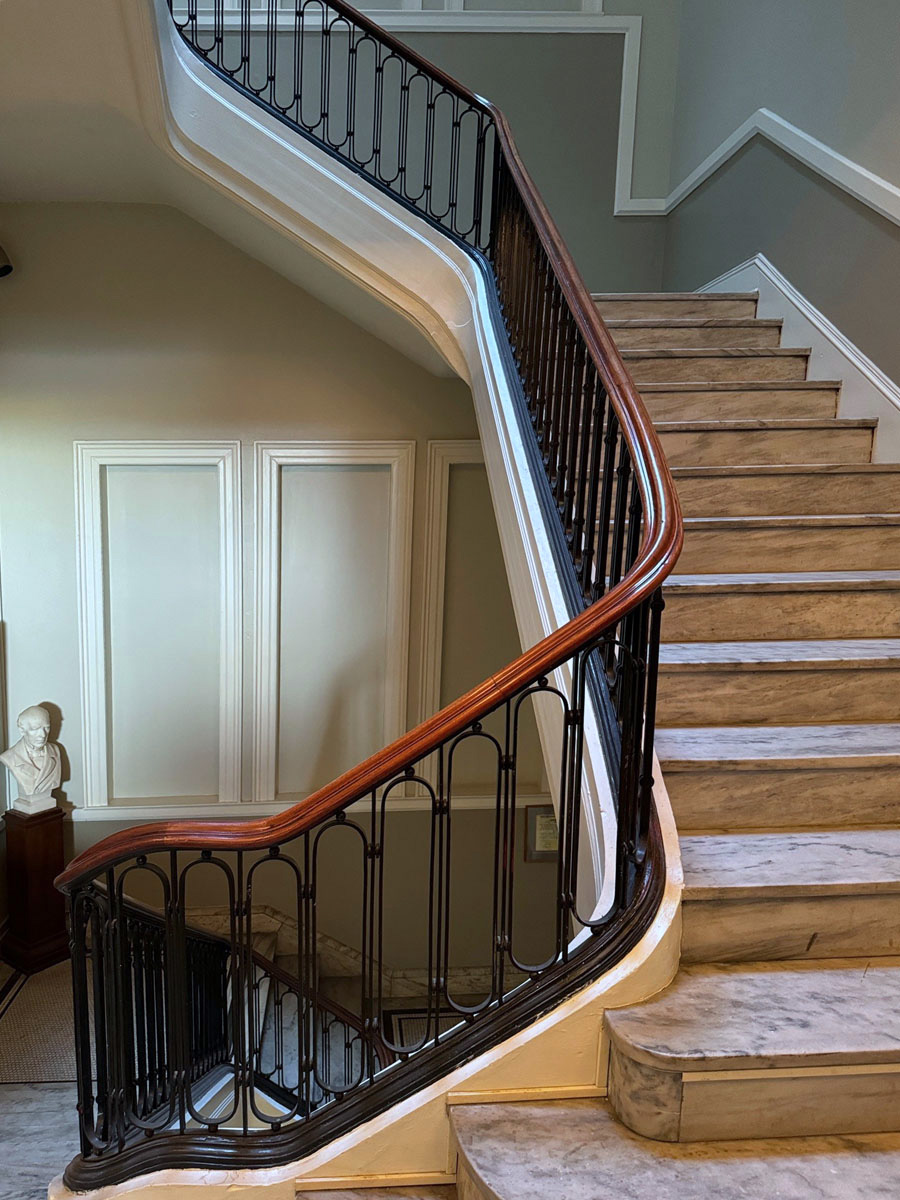
Our Main Staircase

The staircase in our 1909 building is one of its signature design elements. It moves up through our building from the basement to the fourth floor where Marcia's apartment was located. 

On the fourth floor, the stairs are about six feet wide. As you move down through the building, the stairs get wider and wider, causing a funnel-like effect to bring the light through the building. You can get an idea of the size of the openings by the dark spots on the blueprint below. 

There is a skylight at the top of the stairs which we opened several years ago. Read about it here. Opening the skylight made a world of difference to the staircase which had always been very, very dark. 

Each set of stairs is actually three sets, intersected with two landings, as you can see in the image above. From the basement to the third floor, the stairs are Calacatta marble in grey and white pattern. The landings are one-inch by one-inch marble tesserae tiles, surrounded by black marble. 

Originally, there were windows along the south side of the staircase, which would bring in both air and light. When we connected the two buildings, we used that space to add bathrooms and an elevator. You can see that on the blueprint on the right of the first floor.

Because you could suddenly see the whole aspect of the staircase when the skylight was uncovered, we decided to hang some portraits in the stairwell. You can read about it here

I recently made a little video about our staircase, which you can watch on YouTube

Tuesday, July 16, 2024

A Swap Seven Years in the Making!

It was almost exactly seven years ago, when the University of Maryland's Medical School Alumni Association proposed a swap of a portrait they had, for a copy of a portrait we had in our collection. 

We were thisclose to making the swap, when we discovered a letter from the 1850s that mentioned if UM ever wanted to "deaccession" the painting, they had to clear it with the families who commissioned it.

Since this wasn't realistic, we put things on hold. 

Fast forward seven years, Davidge Hall is undergoing a major renovation, and the portrait needed to find a new home.

The portrait is of a man named Tristram Thomas, one of the 101 founders of MedChi, by Thomas Coke Ruckle, Jr. We already have two small portraits of Tristram, but the one from UM would be an amazing addition to our art collection. And we have another painting by Ruckle in our collection, too!

First, it measures eight by five-and-a-half feet!!! He was a tall man, with sloping shoulders, and always carried a gold-headed cane. 

Second, the catch was that he had no association or affiliation with the University of Maryland. He never attended the school. He did not lecture there. He was not a professor there. So, the question is why was his portrait given to the University. We haven't found any information on this.

The swappee was John Crawford, one of the original vaccinators, who was closely affiliated with the University in its earliest days.

John's brother was also a vaccinator and would send threads which had been soaked in smallpox to America. John would re-hydrate them and making a small nick between a person's thumb and forefinger, run the thread through the nick.

Our portrait of Crawford is a charcoal drawing, done in the early 1900s, most likely after an earlier portrait. We had it scanned in a high resolution and printed for the University's collection. 

Oddly enough, we had the Tristram painting here at MedChi from the early 1960s to the mid-1980s, when we gave it back to the University of Maryland for some reason!

Yesterday, on possibly one of the hottest days of the year, we moved Tristram back to MedChi, a distance of just a mile or so.

And we also took Crawford to his new home at the Davidge Hall where he will be hung after the renovation.
Each man is now where he belongs and everyone's happy!

In an article in the 1899 Maryland Medical Journal, the portrait was commissioned by friends and patients in Easton, Maryland in 1845, although the painting is marked 1854. It was "deposited at the University of Maryland for safekeeping."  It is noted that he was tall and spare, with narrow sloping shoulders. He carried a cane with wood from the Mount of Olives, given to him by his son, a naval officer. Tristram Thomas is described as the very model of a polished gentleman.

Thursday, July 7, 2022

Dental School Details

A dear friend of mine, Jerome Gray, is a talented watercolorist, and he recently shared a picture he'd done of one of the buildings where the Baltimore School of Dentistry was located. 

From its initial location at Lexington and Calvert Streets where it was founded in 1839 by Horace Hayden, the dental school moved four more times until it finally became part of the University of Maryland in 1915. 

The Dental School originally met in the homes and offices of its founders and professors before it moved to Lexington Street. From Lexington and Calvert Streets where it shared space with Newton University, the school moved to Lombard and Hanover Streets, which was also the location of the New Assembly Rooms. As it grew, the School moved to an adjacent building where there was more space. Next, the School moved to an 1870's mansard-roofed building at Eutaw and Lexington Street.

Finally, in 1881, the Dental School moved into the first building it had actually owned - the one at Franklin and Eutaw Streets. It never moved very far! 

From the report comes this detailed description of the building:

The Baltimore College of Dental Surgery building, constructed in 1881 on the southeast corner of North Eutaw and West Franklin Streets in Baltimore, is a three-story pressed-brick commercial building. Each of the street facades is three bays wide; the bays are articulated by projecting brick pilasters, and the three stories are defined by granite belt courses. Windows on the second level are tall, paired 2/2 sash with peaked granite hoods decorated with incised, Eastlake-influenced designs; the third story is lighted by triple 1/1 windows, with round-arched granite heads. A projecting bracketed wooden cornice caps the flat-roofed building. A narrow projecting bay between the center and south bays on the west facade defines the original entrance location. The first story has always been given to commercial use; it now features a Streamline Moderne storefront of etched black glass and aluminum, added c. 1942 when the entire building was adapted for use as a department store. The interior of the upper floors (the spaces used by the College and called Infirmary Hall) remains almost entirely intact, retaining the original stair and balustrade, door and window architraves, plaster cornices and medallions; the only alteration consists of the insertion of a mezzanine in the north room of the second floor, which is reversible and was accomplished without significant disruption of original fabric. The building retains a high level of integrity.

Jerome kindly included the Maryland Historic Trust's survey of the last building the Dental School occupied before it became part of UM. It is now called the Charles Fish building and it's always been one of my favorites! 

Monday, August 23, 2021

The Many Faces of Thomas H. Buckler

Thomas Hepburn Buckler was a renaissance man in the mid-1860's. Although he was a physician, his biography in the Medical Annals of Maryland (1799-1899) doesn't have the requisite date of achieving membership at the Faculty. 

Possibly, this is because he was living abroad for a significant amount of time, especially the years of the Civil War. Dr. Buckler was the second husband of Eliza "Didy" Ridgely White (1828-1894), a member of the Ridgely family who owned more than 10,000 acres of land just north of Baltimore, as well as the spectacular Hampton Mansion. 

Dr. Buckler was said to be a man of "striking personal appearance and much sought after on account of his brilliant conversational powers and wit." He and Didy had one son, William Hepburn Buckler, who is remembered as a scholar, lawyer and diplomat. He was born while the Bucklers lived in Paris. 

Over the weekend, I was visiting old churches in Baltimore County with a friend who is researching them and literally stumbled across this tomb-stone. Both father and son are buried at the cemetery at the historic St. Thomas Church in Garrison, Maryland.

Anyway... for all of the time he spent away from Baltimore, and for the fact that he probably wasn't actually a member of the Faculty, we have at least three depictions of him - two oil portraits and one marble bust. 

The most well-known portrait is Julius LeBlanc Stewart's portrait of Buckler. You can read all about the subject and the artist here. This portrait was painted when Buckler lived in Paris between 1866-1890. 

The second portrait is by Louis Dieterich, a Baltimore-based painter. This was probably painted upon Buckler's return to Baltimore, after 1890.
The marble bust is by William Henry Rinehart, a noted sculptor from Baltimore who lived in Rome during the 1870's. The bust is signed and dated 1868, which is handy. 

Additionally, there is a notation in the 1958 catalogue of Rinehart's works of the provenance of this bust, which traces it from TH Buckler to his son, to the Faculty. 
So, I guess my next bit of sleuthing is to search the old medical journals and see when and why we acquired these pieces.