In 1882, Dr. Whitfield Winsey became the first Black member of the Medical & Chirurgical Faculty of Maryland.
Whitfield Winsey was born to William H. and Malvina Gibbs Winsey of Baltimore. The Winseys were a free Black family, and William Winsey earned enough money as a brickmaker to provide a private education for his son, Whitfield.
Whitfield’s mother, Malvina, died at the age of thirty-four. Whitfield's father soon re-married and the new couple appear in the 1860 census with Winsey’s brother Oliver, but Winsey himself was not listed that year. Several sources stated he was privately educated, meaning he could have been away at a boarding school when the census was taken. In 1866, William Winsey, his father, passed away, leaving Whitfield his considerable estate.
In 1867, Winsey began to work with and be tutored in medicine by Dr. John Richard Woodcock Dunbar. In 1871, Winsey graduated from Harvard Medical School, where he was taught by Oliver Wendell Holmes, Sr., the essayist, poet and professor of anatomy, and the father of the Supreme Court Justice of the same name.
In 1872, Winsey returned to East Baltimore and establish his medical practice in his home at 1220 E. Fayette Street. On November 2, 1872, Winsey married Anastasia Jakes. They had three children – William, born in 1872 (died in 1879); Herbert, born in 1875; and Bertha, born in 1878.
Winsey’s wife Anastasia died in 1884 at age 34, the same age as his mother when she died. On April 13, 1882, Whitfield Winsey became the first Black physician admitted to the Medical and Chirurgical Faculty of Maryland. Four members resigned in protest. Earlier in the month, he had been denied membership to the Baltimore Medical & Surgical Society. From the Baltimore Sun: During the 1870s and ‘80s, Winsey’s name appeared in the pension files of several Black Civil War veterans as their physician. This was the beginning of a prosperous career serving Blacks professionally, both as a business and a social service, as can be seen in his later medical associations.
In 1894, a group of prominent Black physicians, including Dr. Winsey, founded Provident Hospital on Orchard Street. This was the first private teaching hospital for Blacks in Baltimore.
In 1897, there was a movement by the Republican party to have one Black man from each legislative district run for the Maryland State House of Delegates. Dr. Winsey ran in the First District, his home district. There is no further record of what happened in this disputed election, so the presumption was that he was not elected.
In 1899, Winsey applied for and was granted a permit from the Board of Medical Examiners of the State of Maryland. The reason for this is not clear, as he had been practicing medicine for 20+ years.
In 1901, Winsey became the treasurer and physician for the Industrial Home for Colored Girls at Melvale, a post which he held until his death eighteen years later.
In 1902, Provident Hospital moved into two remodeled residences on Biddle Street and Winsey continued as an instructor teaching Black internists.
The theft of horses and carriages, which were regularly left unattended while the owner did some quick business, was relatively common. According to the Baltimore Sun, Dr. Winsey’s horses and carriage were stolen twice while he was attending to patients in their homes.
According to his biography in the Medical Annals of Maryland, Dr. Winsey was a Delegate to the International Medical Congress at Washington. In addition, Winsey was the author of several papers he presented before the Faculty, the Clinical Society of Maryland, and the Medical Congress.
Dr. Winsey published an in-depth piece entitled “Some Thoughts on Phthisis Pulmonalis,” (now known as tuberculosis) in the 1886-87 Transactions of the Medical & Chirurgical Faculty of Maryland. The article compared incidents of the disease between the white and Black population of Baltimore. Winsey also became a member of the American Medical Association.
Although Winsey was employed as a physician at Black institutions such as the Melvale Home and Provident Hospital, he belonged to white fraternal and professional organizations, including the Medical & Chirurgical Faculty and the Masons.
Dr. Winsey provided leadership for many aspects of nineteenth century Black society in Baltimore. As a member of the small but growing cadre of Black physicians in the city, the Harvard-trained Winsey served as the Black voice on the Medical and Chirurgical Faculty of Maryland, which he had joined in 1882.
Whitfield Winsey died on July 6, 1919, two months short of his 72nd birthday. Dr. William T. Carr, Jr., one of the founders of Provident Hospital, was the medical attendant who signed Winsey's death certificate.
The Afro-American printed a front-page story on his death, complete with photograph of him under the headline “Baltimore's Oldest Colored Doctor Dies After Long Illness.” The article describes his funeral as follows: “The body was reviewed at the house on Tuesday and hundreds of friends paid their last tribute to an old Baltimorean.
Funeral services were held from St. Katherine’s of Alexandria Church, Wednesday morning at 10:00 a.m.
In his will, Winsey left $500 to his long-time housekeeper, Levinia Cooper, his gold watch and chain to his son Herbert, and the rest of his estate, valued at nearly $24,500, to his daughter Bertha.
Dr. Winsey is buried at the Laurel Cemetery. This former cemetery was originally created in 1852 and previously located on Belair Road in East Baltimore. It is estimated that nearly 10,000 persons of African-American descent were buried on the five-acre site.
It was relocated to its present three-acre site in Johnsville, Maryland about 20 miles west of Baltimore, in 1958 after an attempt to bulldoze the graves was halted by the Baltimore NAACP. About 400 grave markers remain.
Sources:
- The Road To Thurgood Marshall; The Maryland State Archives
- The Baltimore Sun, 1865-1920
- Annals of Medicine in Maryland 1799-1899
- Medical & Chirurgical Faculty Transactions, 1886-87


 There were also pharmacists in the family, and they owned a pharmacy on Park Avenue in Bolton Hill. Some members of the family lived on Eutaw Place, just a few blocks away.

 There is a whole lot going on in this ad, which is really about 20+ ads in one! Here are some of the details from this, and another ad:
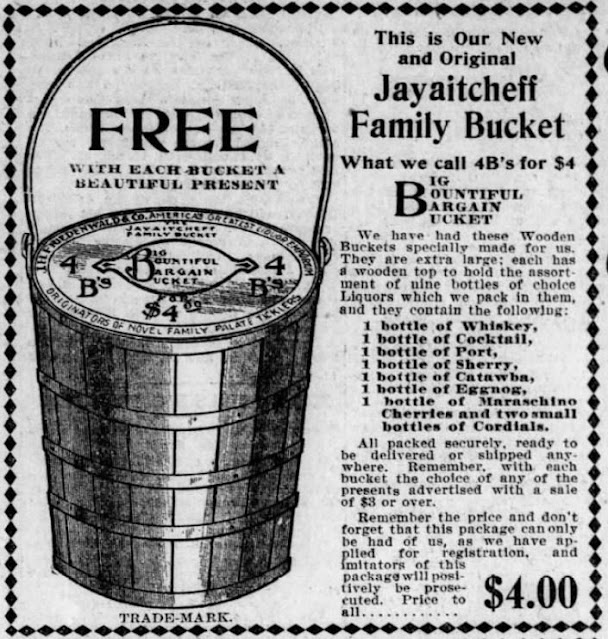 They used the word "jayaitcheff" in a number of their ads, and if you sound it out, it's J H F for J.H. Friedenwald.


