Wednesday, May 25, 2022

After the Work

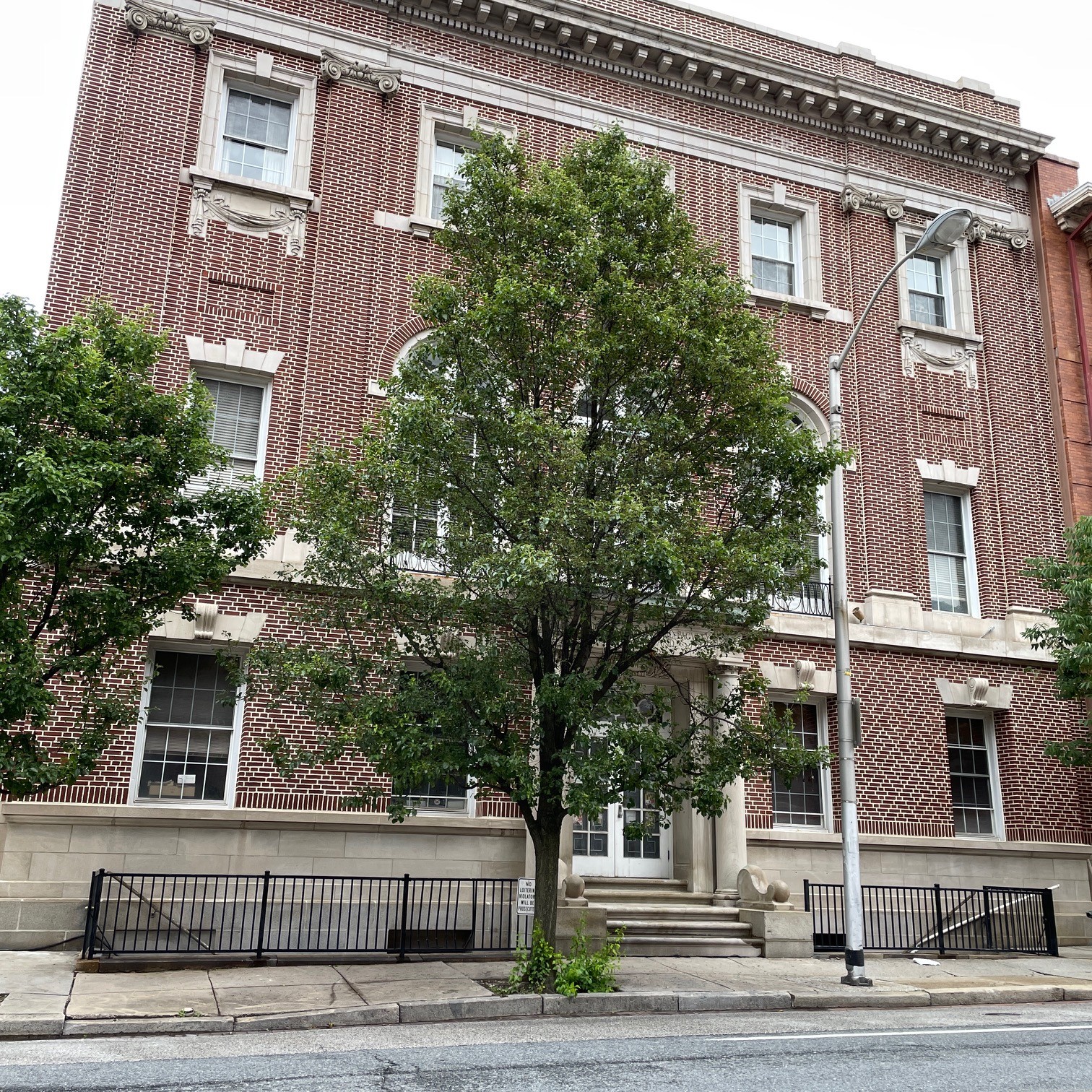
As I mentioned in a post a few weeks ago, we have been having some work done on our historic 1909 building, mostly re-pointing the brickwork on the façade, power-washing the sandstone work and painting woodwork. 

The work has now been completed and the building is looking quite smart and refreshed! As you can see, the fresh mortar really brings out the patterns in the brick - diagonal Flemish bond on the ground floor and monk bond on the upper floors. Click here to see older, more detailed photo of the brickwork.

The building was designed by Ellicott & Emmart, a local firm of architects. A contemporary account says that in addition to numerous meeting rooms and a large hall, there were “several rooms for special purposes in connection with various branches of medical research” including a working laboratory. 

In 1909, the total cost of the building was $64.342.49, with 572,090 cubic feet, making the cost per cubic foot $.112. In 2022 dollars, the building would have cost more than $9 million!

P.S. - It is incredibly difficult to photograph our buildings. Because of the location of the Meyerhoff Symphony Hall directly across Cathedral Street, you can't back up far enough to get a good head-on shot! I think that both of these shots were taken through my car window.

Monday, May 23, 2022

The Knipps: Generations of Physicians

From our friend, member, and physician, Harry Knipp, MD: 

I recently found an old book that dad, Harry Lester Knipp, MD, had given me years ago. It was on the shelf at 4116 Edmondson Avenue when they were packing up the office in 1977 to move to Frederick Villa. The book is a 1930 2nd edition printing of Aequanimitas, Dr William Osler's addresses to medical students, nurses, and other practitioners of medicine, originally published in 1904.

The inside front cover had two inscriptions. The uppermost was that the book had been given to Gertrude B. Knipp (GBK) of 1821 Park Avenue in Baltimore by Donald and Grace [Belt] in 1932.  Donald Belt was GBK's nephew, more on that below. The second inscription was dated Dec. 31, 1949, when GBK gave the book to my grandfather: “For Dr. George A. Knipp with much love, GBK.” Squeezed in between those lines, as an afterthought might appear, she added our dad, Dr. Harry Lester Knipp, who was a new medical student at University of Maryland at the time.

I had not heard much if anything about Gertrude Knipp growing up, probably because she passed away in 1952 and had never married, so there were no ongoing relatives. This got me to do some digging…

Gertrude Bitzel Knipp (GBK) was the 2nd daughter and 2nd child of John Jacob Knipp, Jr (1833-1909) and his wife Elizabeth Bitzel.  Jacob, Jr. was the first child and eldest son of the first Knipp to come to Baltimore from Germany in 1832, John Jacob Knipp, Sr. and his wife Anna Gengnagel Knipp. Jacob, Jr. worked in a dry goods store at 33 N. Howard Street. 

Donald (1891-1960) was the son of Jacob, Jr’s third child Mary (Mazie) Knipp (the next child after GBK), and her husband William Belt. It was Donald Belt, who gave GBK the above-mentioned book.

Mazie and William's oldest child, Donald's big sister, who never married, was Mabel Knipp Belt, M.D. (1888-1927). She graduated from Western High School, received her AB from Goucher, and was Phi Beta Kappa in 1910, and M.D. from Hopkins in 1914.

Dr. Mabel Knipp Belt was a Med Chi member and also the American Association of University Women. She had a private medical practice in the Arundel Apartments at Charles Street and Mt. Royal Avenue and was school examiner for a number of high schools, including Friends.

GBK graduated from Goucher College with an AB degree in 1897. She immediately began working as a reporter for the Baltimore Sun, and was only the second female reporter they had hired (confirmed in commentary by them in her 1952 obit).

GBK remained at the Sun until 1905 and then moved to the Baltimore News American for another 2 years. Her biggest scoop at the Sun was in 1901, breaking the news well before it was announced publicly that Dr. Daniel Coit Gilman would be retiring as President of Johns Hopkins University. Amazingly, she had overheard Hopkins staff discussing it on the streetcar, attributing her scoop to “sheer dumb luck!”

For this scoop, she was awarded a solid gold coin.  Her Sun salary was $10/week. It is interesting that the inscribed book that started my search is dedicated by Dr. Osler to Dr. Daniel Gilman, the “ex-President of JHU, for his guidance in those happy days in 1889 when Johns Hopkins Hospital was organized and opened.”

GBK also got to interview Baltimore's Cardinal Gibbons.

In Sept. 1907, GBK was the press representative for the International Congress on tuberculosis. After her newspaper career, GBK went on to be the Executive Secretary of the American Association for the Study and Prevention of Infant Mortality (AASPIM). She played a major role in that organization and attended many national meetings. Her offices were in the Medical & Chirurgical Faculty’s building on Cathedral Street.

She is even mentioned in a 1919 edition of the Charlotte Medical Journal, noting the election of officers at the AASPIM’s annual meeting in Chicago.  She was an editorial assistant at the Maryland Board of Health for many years. In 1939, she took a position with the Maryland Department of Health as Chief of the Division of Public Health Education (confirmed in the Maryland Manual) and was there for many years.

GBK lived in Reservoir Hill in a big beautiful 1910 townhouse at 1821 Park Ave, near the corner of Lennox Street. There are terrific pictures of the house and its renovated interior on real estate websites on-line if you search the address. She passed away at her home on October 27, 1952 after an illness of several months. Her funeral was held at the historic Tickner's Funeral Home on the corner of North and Pennsylvania Avenues where Dr. George Knipp’s services were held in 1964. GBK is buried in Loudon Park Cemetery where most of the family has been interred.

Some additional commentary: Interesting that after four years as DHMH (Dept of Health and Mental Hygiene), the state health department went back to its earlier, more compact name, the Maryland Dept of Health (MDH).

By the way, speaking of long-term “employment” at DHMH/MDH, I worked there in an official capacity pro bono for a total of 27 years – 17 as a founding member of the Radiologic Technology Committee of the Board of Physicians Quality Assurance, going back to 1983-84 when it was still the Board of Medical Examiners, and through the short period of the Commission on Medical Discipline; then another 10 years at the Maryland Board of Physicians, including two terms as chair and ten years as chair on the Investigative Review Panel.

As to Hopkins Hospital... organized in 1889, the year George A. Knipp, MD was born, the University of Maryland School of Medicine began in 1807 and University Hospital was born in 1823 as the Baltimore Infirmary, the nation’s first medical school teaching hospital. I bet if you ask the general public, they'll say Hopkins is older. 

Hopkins did beat Maryland in graduating women physicians. Our cousin Mabel Knipp Belt, MD, as above, graduated from there in 1914. She had her offices in the Arundel Apartments, formerly on the south-east corner of Charles Street and Mt. Royal Avenue. 

The first female grad of UMSOM was in my grandfather's class of 1923, Dr Nancy Snaith.  In a shocker, Dr. Mabel Belt died of a sudden heart attack at age 39 while in a store at 303 N. Charles Street, (in family history while listening to a record of "The Lost Chord"). 

As to Goucher, our Dr. Minnie B. Knipp (b1896), my great aunt and older sister to Dr. George A. Knipp, also received her undergrad degree at Goucher in 1915 and went on to get a masters from Cornell and then her doctorate from Hopkins, thus beginning her long career as a professor of education at Washington College in Chestertown. In the May 1923, Goucher Alumni Quarterly, there's a nice article on Dr. and Mrs. Goucher written by alum GBK! 

 Submitted by:
Harry Knipp, MD
May 23, 2022

Thursday, May 19, 2022

An Eyewitness to the Founding of JHH

The Maryland Center for History & Culture, formerly the Maryland Historical Society, recently shared an eyewitness account to the earliest years of Johns Hopkins Hospital. It was written by a former President of the Faculty, Lewellys F. Barker, whose portrait we also hold in our collection. 

Dr. Barker was a Quaker from Canada, as were a number of the early Hopkins physicians. In 1906, Dr. Barker was named as Dr. William Osler's successor as Professor of Medicine and Physician-in-Chief at Johns Hopkins School of Medicine.

The article talks about Dr. Barker's early days at Hopkins and then the years following its founding. The post was in reference to the fact that today is the anniversary of the 1775 birth of the founder, Johns Hopkins.

There is also a brief reference to the Faculty and Marcia!

A link to the article is here. You can read about the house where Dr. Barker lived in Guilford here. 

Tuesday, May 10, 2022

Another Year Older!

This week, we celebrate the birthday of our beloved building at 1211 Cathedral Street, built in 1908-1909, and dedicated on May 13, 1909. Dr. William Osler came from England for the dedication of the building, which had been his brainchild for many years. 

The building is undergoing some changes right now, with a huge project to repoint the bricks on the entire façade of the building. Initially, we thought we'd only have to repoint a portion of the front, but once the workers got started, we quickly realized that the way to go was to repoint the entire thing. Hopefully, that work will last for another 100+ years!

In addition to repointing the exterior, the workers will paint all of the wooden parts and power-wash the sandstone sections to brighten them. As you can see in the photo above, there is significant discoloration due to the numerous passing cars on Cathedral Street, just a few feet away, and from some leaching from copper gutters. 

As for the interior, there are some changes there as well. Because of the number of staff working from home most days, we find ourselves with a surplus of space.

We are planning on opening a "museum" here in the fall, probably in September. The proposed museum space is outlined above in red. 

For the past 113 years, our building has served us well, changing with the times, adapting to new technology and always remaining the elegant space we call our work home.

Tuesday, April 26, 2022

The Pratt & MedChi

When Dr. William Osler became President of the Faculty in 1896-97, one of his missions was to completely update the pitiful books, pamphlets and periodical publications that made up the library. 

The Pratt, as it's known, was located on Cathedral Street between West Franklin and West Mulberry Streets, just around the corner from Dr. Osler's residence on West Franklin Street. 

The original branch of the Pratt had opened in 1886, and by 1894, it had one of the largest collections in the country. However, the growing collection meant that a new building was necessary and by 1931, the library's staff, services and 400,000 volumes had moved to temporary quarters at Redwood Street and Hopkins Plaza while the original building was demolished and a new building was constructed on the original site. 

One unique feature of the newly built main library was the huge windows, akin to those at a large department store, for showing off the books held in the library's collection. Unusually, it featured an open, light-filled main hall.

Backing up a few decades to 1896, Dr. Osler needed a trained librarian to manage the Faculty's peripatetic collection of books, which had both grown and shrunk over the previous half-century, and so he consulted his friend, Bernard C. Steiner, the head of the Enoch Pratt Free Library for a recommendation.

Within two weeks of her interview with Dr. Osler on behalf of the Library Committee, Miss Marcia Crocker Noyes had accepted the position of librarian at a salary of $300 per year, and moved into an apartment in the Faculty’s building at Hamilton Terrace.

At that time, librarians were expected to be on call 24/7. A physician could ring and request a book. The librarian would search the card catalogue and pull the book from the shelves. The physician would arrive shortly thereafter, consult the book, and hurry back to his ailing patient.

While Miss Noyes knew how to catalogue and how libraries worked, she knew nothing about medicine. She said that she trained herself for the job by just doing it. She was more than willing to learn, and Dr. Osler was a good and patient teacher. 

MedChi's association with the Pratt continues to this day, and over the decades, some of our board members have also served on the Pratt's board.


Thursday, April 14, 2022

Reynaldo L. Lee-Llacer, MD

 Dr. Reynaldo L. Lee-Llacer, of Stevensville, Md, passed away on April 8, 2022 at age 88. Among his many life experiences and accomplishments, he treasured most his 60-year marriage to the love of his life, Zorayda.

His story begins with his birth in San Fernando, Masbate, Philippines on May 25, 1933. As a youth he dreamed of being in the military, but ultimately chose a career in medicine. He attended the University of Santo Tomas in Manila, Philippines where he participated in ROTC and earned his medical degree in 1958.

After a three-year tour on his home island of Ticao, managing a typhoid epidemic and cholera outbreak, he left for the United States in 1962 and completed an internship and surgical residency at Prince George’s General Hospital in Maryland. He then completed a fellowship in Shock Trauma at the University of Maryland Hospital in Baltimore, where he published scientific medical research. After two years of practice as the House Surgeon in Fairfax Hospital, Va., he opened a private surgical practice in Clinton, Maryland. Through his tireless dedication he cared for and treated countless patients for 50 years.

Dr. Lee-Llacer was board certified in General Surgery and was a Fellow of the American College of Surgeons. As his expertise grew, he was called on by many medical organizations to serve in leadership roles. He was appointed by Governor Harry Hughes to the Board of Physician Quality Assurance.

Reynaldo Lee-Llacer was President of the Prince George’s Medical Society, President of the Medical Staff at Doctors Community Hospital, Prince George’s Maryland, President of the Medical Chirurgical Society of Maryland (Med Chi), elected Maryland Delegate to the American Medical Association for 16 years, President of the Society of Philippine Surgeons in America, President of the Philippine Medical Association of Metropolitan Washington, DC, President of the PEACE Foundation, Founding member of D’Bicolanos & Friends, Founder & First President of the UST Alumni-Thomasian USA, and Founder of the Philippine Medical Foundation.

He served on numerous committees and councils in the state medical society and Doctors Community Hospital, as well as other organizations. The Maryland Legislature often called him to testify on medically related matters. Dr. Reynaldo Lee-Llacer was a beacon of Maryland medicine and served humbly in the service of others.

He lived in the service of the Lord as a devout Catholic. He was an unselfish and giving individual who spent his own personal time and money serving on surgical medical missions in his beloved birth country of the Philippines. The Maryland Medical Journal dedicated issue to Reynaldo Lee-Llacer 1990, the UST Alumni Association Leadership Award 1990, Twenty Outstanding Filipinos in the United States 1993, Distinguished Son of Masbate 2005, Outstanding Service to the Filipino American Community 2005; the Dakila Achievement Award 2007, the UST Total Award 2016, and the first PMA Management Award are among the many honors Reynaldo Lee-Llacer received for his dedication, generosity, and humanitarianism. 

His love for medicine and care for his patients were only eclipsed by his adoration and love for his wife Zorayda, his five children, and eight grandchildren.

Dr. Lee-Llacer was an avid lifelong learner whose interest spanned beyond medicine. An artist himself, he admired and collected art. Among his many interests he loved to travel, read, play guitar, sing, dance, play chess, do crossword puzzles, write poems, and study world history. He was a true patriot of America and avidly supported US military organizations, veterans, and first responders, including law enforcement.

Submitted by the family of Dr. Lee-Llacer

Friday, March 25, 2022

Save the Date for Star Wars!

Please Save the Date!

Please join the Center for a Healthy Maryland,
MedChi and the BSO
For lunch and a showing of
STAR WARS: RETURN OF THE JEDI
W
ith live music by the Baltimore Symphony Orchestra 


DETAILS
The Annual BSO/Center for a Healthy Maryland/MedChi Concert Event
Saturday, May 14, 2022
12:30 :: Guided Tour of the Historic MedChi Building
1:00 :: Lunch & Brief BSO Presentation 
3:00 :: Star Wars: Return of the Jedi
. . . . . . . . . . . . . . . . . . . . . . . . . . . 
The Lunch and Tour will take place at MedChi
(1211 Cathedral Street)
The Movie and Concert will take place at the Meyerhoff Symphony Hall
(1212 Cathedral Street)
 . . . . . . . . . . . . . . . . . . . . . . . . . . . . . 
MedChi Members and Their Guests: $85/person
Medical School Students, Residents Plus ONE Guest: $20/person
Additional Student/Resident Tickets are $45/person
 
COSTUMES ARE ENCOURAGED!


Supported Through the Generosity of MedChi Members and Donors

Free and paid parking are available in close proximity to MedChi and the BSO.

Please
click here to review the BSO's COVID protocols.